For sale on www.artpal.com/laurabernnelson
www.saatchiart.com/lauraartist68
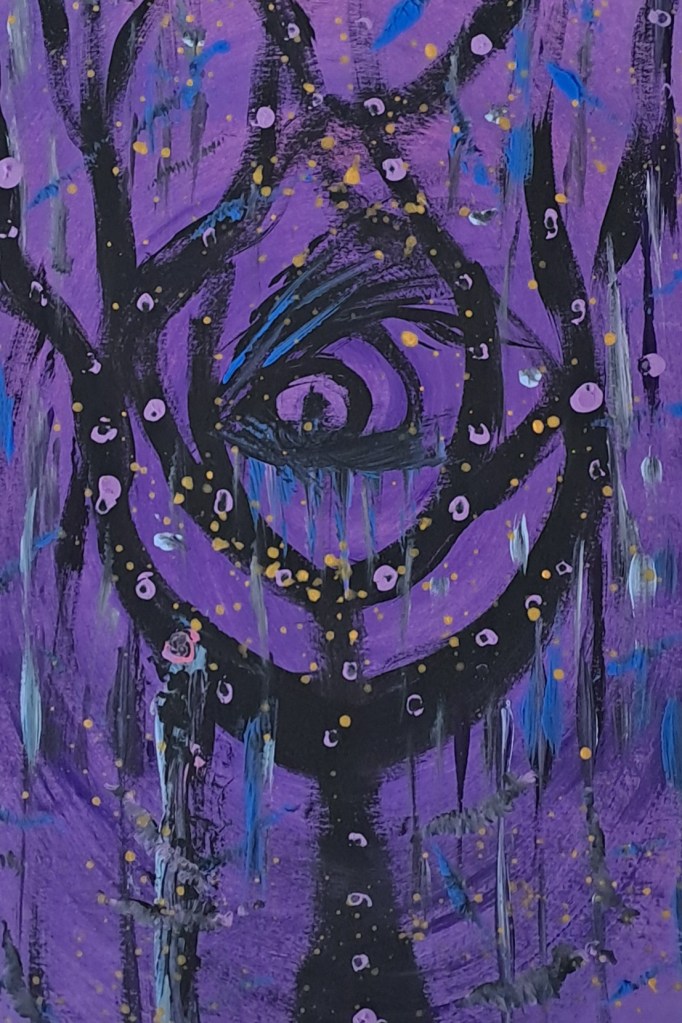
Title: The Eye Tree
Medium: Acrylic on Paper (Unframed)
Size: [Insert actual dimensions of the paper here if available]
Signed: Front and back by the artist, Laura Bernardeschi Nelson
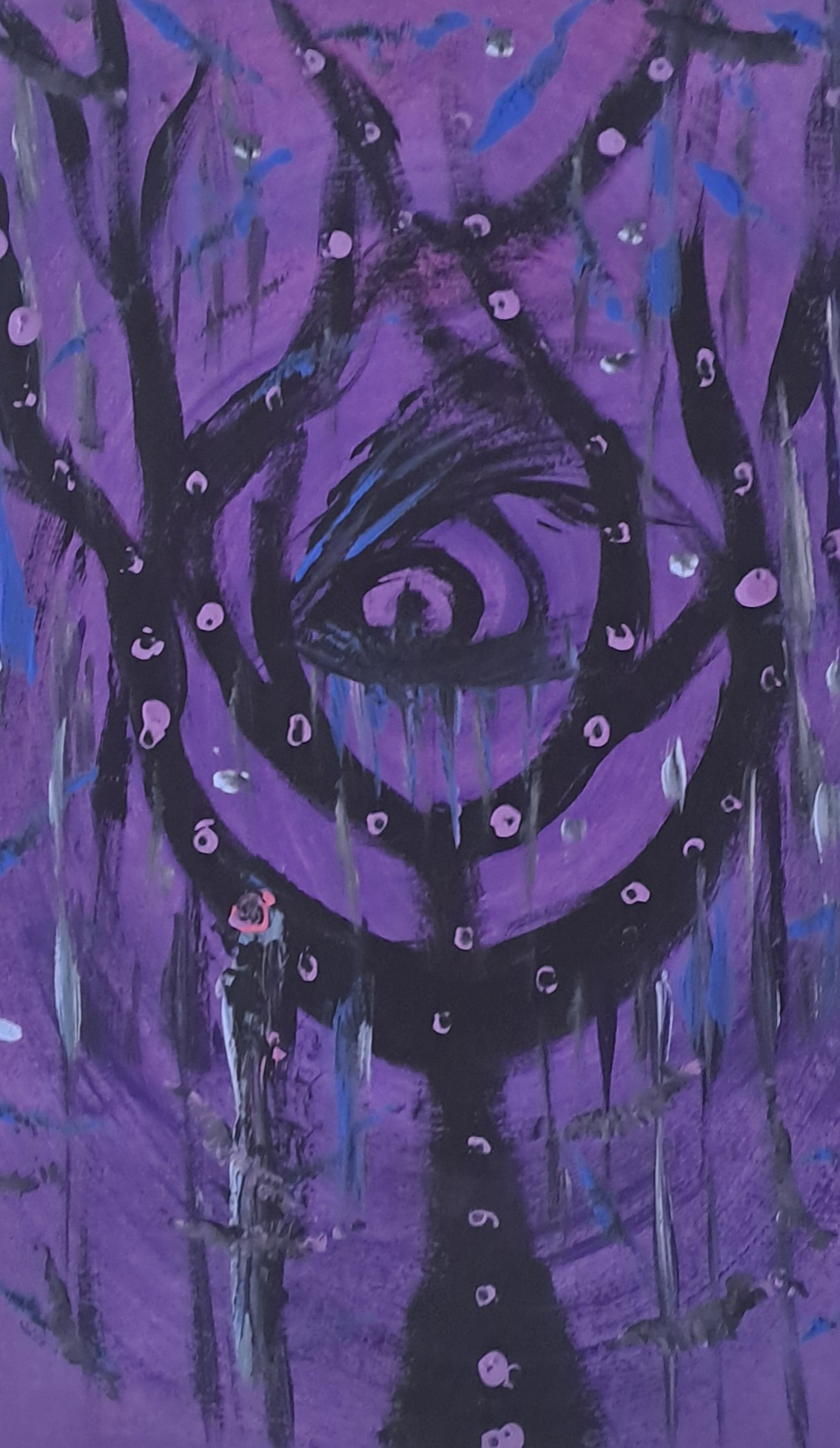
In The Eye Tree, Laura Bernardeschi Nelson explores the surreal terrain of the subconscious, where trees are sentient, eyes emerge from bark, and dreams unfold in violet twilight. This acrylic-on-paper painting — sold unframed — is a rich meditation on inner vision, intuition, and transformation.
A mysterious black tree dominates the composition, its branches stretching outward like open arms, or perhaps reaching thoughts. At its center, embedded within its core, is a striking eye — not merely watching, but almost awakening within the tree. Its gaze is not threatening, but omniscient — a quiet witness to the secrets held within the cave of the self.
Laura’s dream world is populated by symbols: the tree, often representing life, growth, and rootedness; the eye, an ancient emblem of knowledge, soul, and perception. Here, the two converge into one being — a hybrid presence emerging from the artist’s deep dream consciousness.
Set in hues of violet, indigo, and shadowed black, the palette evokes a dreamlike dusk — that in-between moment when day slips into night, and the conscious mind loosens its grip. Accents of pale pink, white, and occasional blue strokes create motion, as if thoughts are dripping, falling, or perhaps rising like mist in the forest of the mind.
This is not a passive landscape — it is a psychological portrait, a surreal invocation of the unseen realms. As with much of Nelson’s work, The Eye Tree invites the viewer to go inward. The tree is not just a tree. The eye is not just an eye. They are archetypes — living symbols pulled from the depths of personal myth, universal and yet intimate.
What watches us when we think we are alone? What grows inside when we are still? What does it mean to be seen by something deeper than the surface? The Eye Tree asks without answering. It simply is, and in that is-ness, it awakens something in return.
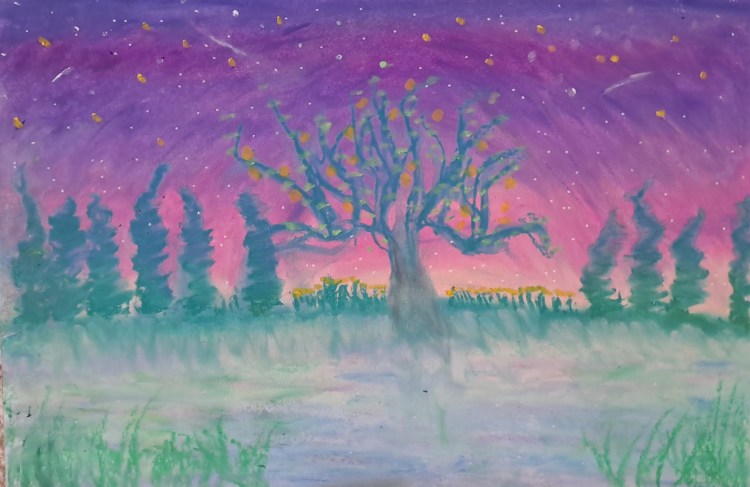
In her radiant new acrylic painting The Golden Orchard of Dusk, Italian surrealist Laura Bernardeschi Nelson offers yet another glimpse into the rich symbolic terrain of her dream life. This unframed artwork, signed both front and back, is neither an imagined landscape nor a literal place — it is a distilled memory from the dream realm, interpreted in color, form, and light.
As with much of her work, Laura’s creative process begins not with a concept, but with an atmosphere — a place or presence that visits her in dreams. This time, it was a solitary orchard, or perhaps a sacred tree, standing in a field bathed in violet and rose light. In the dream, the sky was not only above but seemed to enfold everything — a canopy of stars and ripe fruit suspended in stillness.
A Dream of Ripening Time
The painting itself is a vision in gentle motion: a wide meadow stretches out under a vibrant twilight sky. The soft mist of green at the base contrasts beautifully with the dense hues above — a sky streaked in purples, indigos, and deepening pinks, lit by golden flecks that could be stars or falling fruit. The centerpiece is a tree, its form gentle and slightly surreal. Its branches curl and stretch, bearing luminous golden shapes, each glowing faintly as if lit from within.
There’s no overt narrative here. No figures, no path. And yet, the painting tells a story — a silent one. The kind of story you feel rather than hear. It is the story of ripening, of something becoming. Of nature watching itself grow.
Laura often dreams of trees and strange light — symbols she returns to again and again. Trees for her are more than botanical beings. They are timekeepers. Memory holders. Watchers. And in this piece, the tree feels like a presence — not a background element but a character with agency, consciousness, even wisdom. It stands alone but not lonely, surrounded by twilight and stars, like a sage in meditation.
The Philosophy of Ripeness and Stillness
In philosophical terms, The Golden Orchard of Dusk can be read as a meditation on kairos — the ancient Greek concept of “the right or opportune moment.” Unlike chronos, which is linear, kairos is qualitative — it speaks of timing that is felt, not measured. This tree, heavy with golden fruit at the edge of night, lives in kairos. It is not in a hurry. It knows the time is now.
The glowing orbs on the branches are particularly evocative. Are they fruit? Stars? Memories? Possibilities? Their dual nature is the painting’s secret strength. They could be all of the above. That ambiguity allows viewers to meet the image wherever they are in their own lives — to project their own longing or recognition into it.
The sky — that vast, cosmic field — is not merely decorative either. It plays an active role in the dream’s mood. It is both beautiful and solemn. Soft and immense. The stars seem scattered, not fixed. It reminds us that not all constellations are in the heavens. Some grow from trees. Some bloom within us.
A Landscape of the Inner World
As in many of her dream-inspired works, Laura is not painting a scene from life, but a symbolic space of the inner world. Her use of surreal yet gentle distortion — the slightly curved lines, the unreal coloration, the luminous elements — evokes the sense of “thinness” that dreams often carry, where dimensions fold into one another and time has no direction.
The tree is the axis mundi — the world tree, the bridge between earth and sky, the center of the inner landscape. It anchors the scene without dominating it. Around it, the horizon glows faintly with the last light of the sun, hinting at something precious just passed — or just about to arrive.
The Art of Remembering Dreams
Laura once described her process as “a conversation with sleep.” She does not control what images come to her in dreams, but she honors them when they do. She records them in notebooks, sometimes in words, often in sketches. Later, when waking life permits, she translates them into paint — not to explain the dream, but to give it voice.
In this way, The Golden Orchard of Dusk becomes a living memory — not of something that happened, but of something that was felt. It is less about what the dream meant, and more about how the dream moved her.
The artwork invites us to consider: What if some parts of us only ripen in silence? What if the most fruitful moments are not busy or loud, but still — unnoticed even — like a tree bearing gold under a quiet sky?
A Portal, Not a Picture
As with much of Laura Bernardeschi Nelson’s work, this painting functions as a portal, not merely an image. It opens something in the viewer — a slowness, a nostalgia, a sense of the sacred. It evokes the moments we rarely speak of but never forget: standing alone at dusk, watching the sky bloom; feeling that life is both impossibly brief and infinite at once.
In a time of urgency and speed, The Golden Orchard of Dusk is an invitation to pause, to ripen inwardly, to return to the places we forget while awake — those quiet fields inside us where memory and light still grow.
 Laura Bernardeschi Nelson artworld and travels