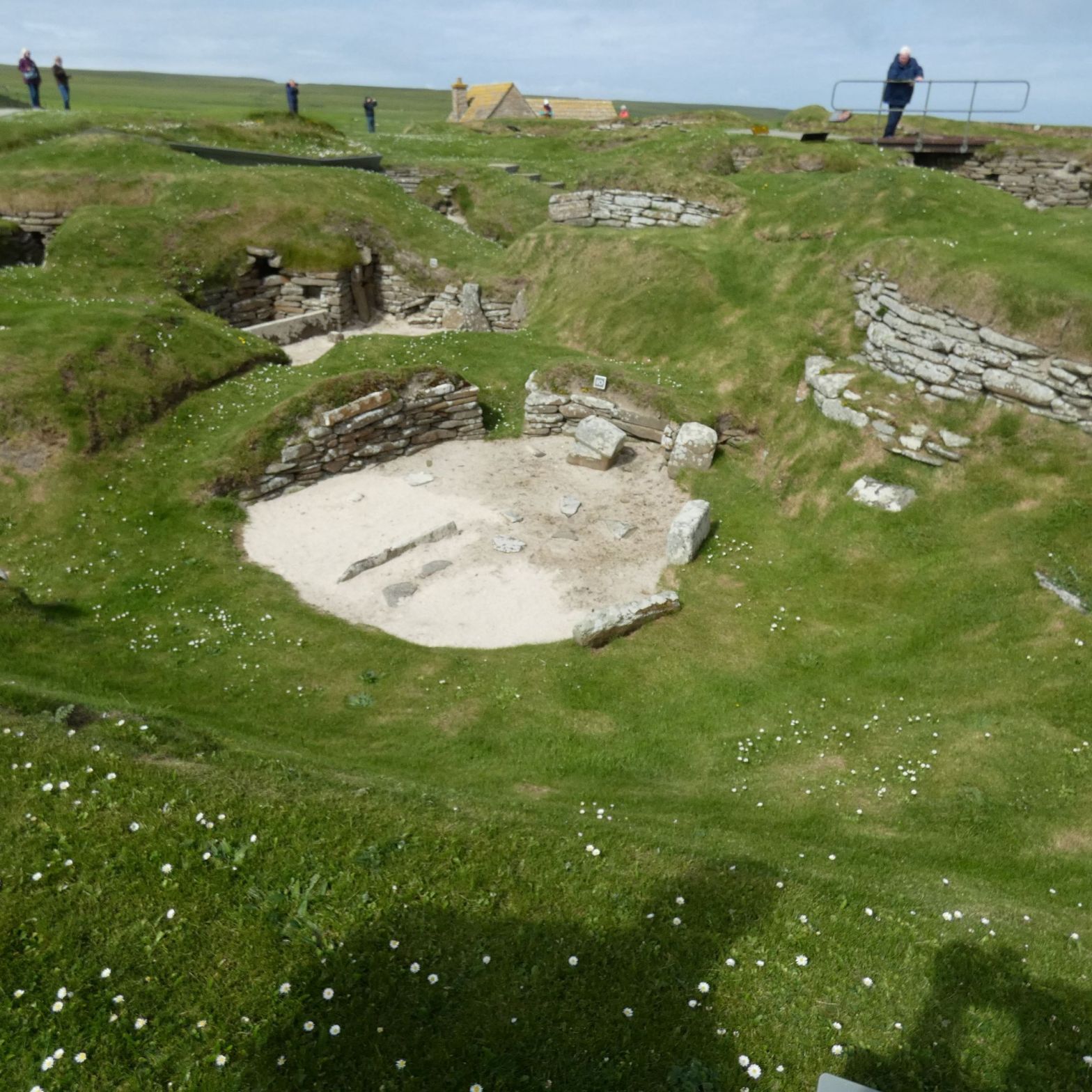

Kirkwall, the capital of the Orkneys.
After our first night in Kirwall, we decided to discover this town the following morning.
Kirkwall is a bustling, busy town, but it’s one with a historic centre full of character. Officially a Royal Burgh since 1486, Kirkwall’s name comes from the Norse ‘Kirkjuvagr’, meaning ‘Church on the Bay’, and a Viking spirit still runs through the town, focused on the magnificent St Magnus Cathedral.
There are many shops where you can find the right souvenirs or gifts for your friends and relatives.
The prices are quite expensive, by the way. For example, I wanted to buy a handmade wool hat, but I declined the idea because it cost more than fifty pounds.
There are lots of alternative coffee shops, also for vegans and vegetarians, and I was pleased to notice that no Cafe’nero, McDonald’s, or Costa have arrived on the islands.
After discovering these shops, my husband and I decided to visit the interesting museum in the town that shows the history of the Orkneys from prehistoric times to nowadays.
I was really surprised to see how much history there is on the Orkneys, especially the period connected to the Neolithic. There is also a large collection of old photos and activities to amuse younger visitors. The Museum’s collection is of national importance, hosting a recognised national archaeology collection, and it has a changing temporary exhibition programme.
The Orkney Museum used to be a house called Tankerness House. For three centuries, this house was the home of the Baikie family of Tankerness, whose estate gave the house its name. The north and south wings were originally manses for the cathedral clergy. After the Reformation, Gilbert Foulzie, the first Protestant minister, built the arched gateway that bears his coat of arms in 1574. It opened as a museum in 1968 and is an A-listed building. The Baikie Library and Drawing Room gives the visitor an idea of how the house looked when it was a family home.
Saint Magnus Cathedral.
Opposite the museum is this important cathedral, created in honour of Saint Magnus and known as the ‘Light in the North. It was founded in 1137 by the Viking Earl Rognvald in honour of his uncle St. Magnus, who was martyred here in Orkney. The Cathedral belongs to the people of Orkney, and its doors are open to all.
Five minutes walk from the cathedral are the Bishop’s Palace and Earl’s Palace, but if you want to visit them, you need to pay for a ticket.
I decided instead to leave Kirkwall at lunchtime because it was too busy after the arrival of hundreds of American tourists due to a cruise, and with our Tesla, we set out to explore the countryside of the Mainland towards the famous Neolithic centres.
The group of Neolithic monuments on Orkney consists of a large chambered tomb (Maes Howe), two ceremonial stone circles (the Stones of Stenness and the Ring of Brodgar), and a settlement (Skara Brae), together with several unexcavated burials, ceremonial, and settlement sites.
All these monuments are part of Unesco, the World Heritage Centre.
The Stone Circle of Stennes
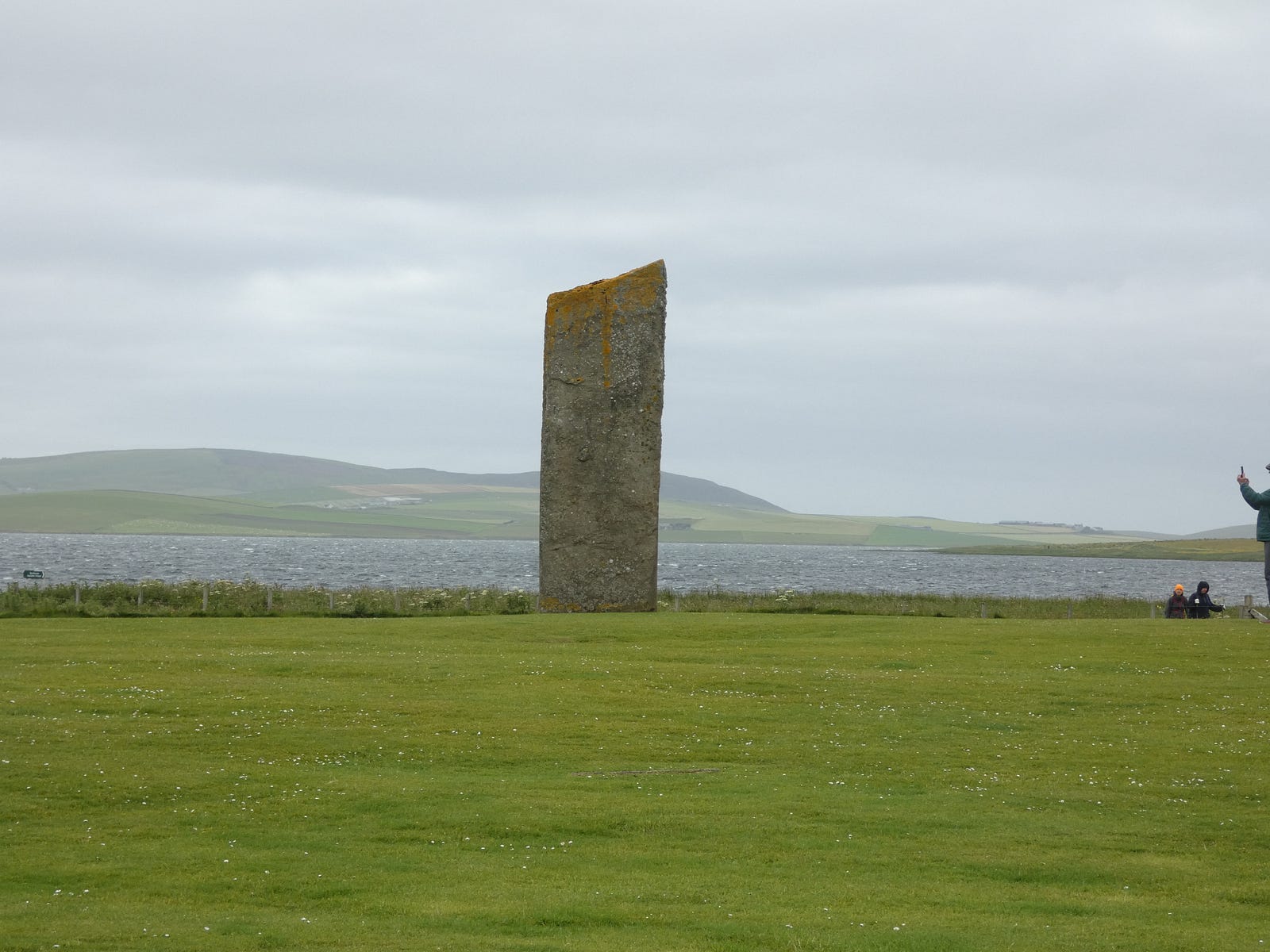
We started with the Stones of Stennes, just 20 minutes driving from Kirwall. They are magnificent, and the best thing is that you are allowed to touch them (this experience is prohibited at the more famous Stonehenge).
Unfortunately, there are lots of coaches full of tourists on the island, so if you want to take a picture without people at these stones, you must wait a few minutes.
Step back in time over 5000 years at what may be the earliest henge monument in the British Isles. The enormous Stones of Stenness are all that remains of a great stone circle on an ancient ceremonial site.
The Stones of Stenness today consist of four upright stones up to 6 metres in height in a circle that originally held 12 stones. The focus of the interior was a large hearth. The stones were encircled by a large ditch, but they have been lost over time by ploughing.
The Ring of Brodgar.
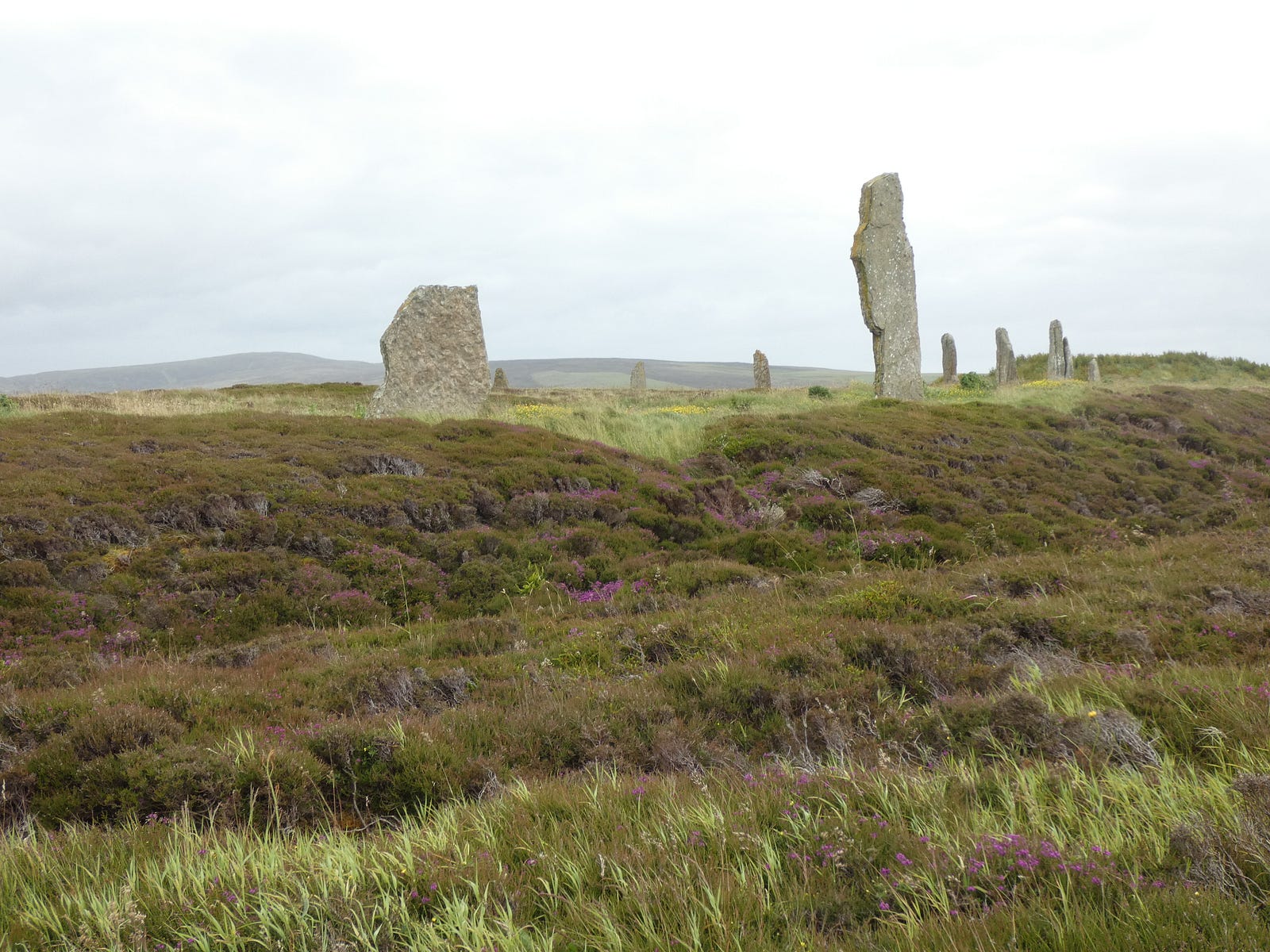
In just five minutes of driving, we can visit this neolithic centre.
The Ring of Brodgar Stone Circle and Henge is an enormous ceremonial site dating back to the 3rd millennium BC.
There is no ticket to pay, but unfortunately, it is not possible to touch the stones. It is a massive stone circle, originally consisting of 60 stones, but only 36 survive today. There are 13 prehistoric burial mounds and a large rock-cut ditch surrounding the stone circle
The Scottish geologist Hugh Miller, visiting in 1846, wrote that the stones ‘look like an assemblage of ancient druids, mysteriously stern and invincibly silent and shaggy’.
This circle is just 2000 years younger than Stennes and was built about 3000 years ago.
Before going back to Kirkwall, we decided to visit the visitor centre connected to MaesOwe. We did not book a ticket to visit it, but we were lucky enough to find a space in the guided tour at 5 pm.
Maesowe

The great Neolithic tomb of Maeshowe is the grandest and most impressive tomb in Orkney. Built about 5,000 years ago, it’s older than the pyramids built by the Pharaohs of Egypt. The structure sits amongst farmland in Stenness. It forms part of the Heart of Neolithic Orkney World Heritage Site and is linked to the great ceremonial stone circles nearby.
Maeshowe was built on a natural hillock, only slightly higher than the surrounding land. This mound was levelled in Neolithic times and covered with a layer of white clay to create a flat surface to build on, or maybe for a ritualistic purpose as the layer is quite thin. Our guide highlighted for us with her torch old graffiti left by a group of 100 Vikings who decided to spend a few nights in the tomb with the excuse of a snowstorm.
You cannot visit the tomb by yourself, and it is better to book your tickets online. A minibus connects the tourists from the visitor centre to the tomb. Once on the archaeological site, you must walk for around 5–10 minutes on a path next to curious cows or young bulls, safely kept away from us.
We were lucky that day because it was not raining and we could enjoy the sun that was warming the green fields around us.
At the end of the visit (it lasted 60 minutes), we went back to our car, ready for an amazing dinner in a famous restaurant in Kirkwall.
This time we had booked the table on time and at 8 pm we sat in the “Storehouse restaurant with rooms”, where Prince William and Kate enjoyed their Westray Crab, Smoked Salmon and Orkney Cheese.
At the end of our dinner, we had a last pint of local beer in a pub next to our hotel, and at 11 pm, happy but tired, we retired to our bedroom, ready for the next adventure.
Thanks for reading
 Laura Bernardeschi Nelson artworld and travels